Class 9th science{physics}(motion)
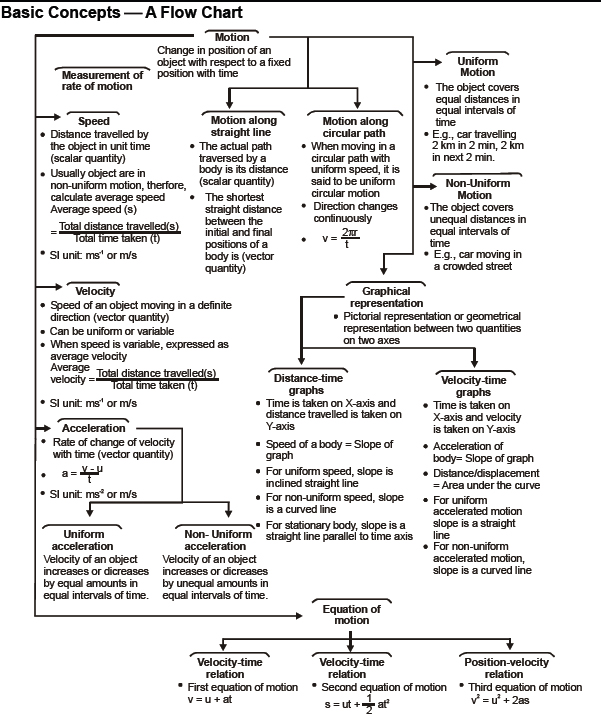
Distance�Time Graphs
• For a body at rest
• As the slope is zero, so speed of the body is zero.

• For a body moving with uniform speed

• For accelerated motion.
• The slope of graph is increasing with time

• For decelerated (speeding down) motion.
• Slope of graph is decreasing with time

Velocity�Time Graphs
• When a body moving with a uniform velocity.
• The slope of AB indicates zero acceleration

• When a body starts from rest and moves with uniform acceleration.
• Greater is the slope of v-t graph, greater will be the acceleration

• When a body is moving with uniform acceleration and its initial velocity is not zero.

• When a body is moving with increasing acceleration.
• Slope increases with time.

• When a body is moving with decreasing acceleration.
• Slope decreases with time.

• When a body is moving with a uniform retardation and its initial velocity is not zero.
• As θ > 90°, graph has a negative slope.

Facts that Matter
• An object is said to be in motion when its position changes with time.
• We describe the location of an object by specifying a reference point. Motion is relative. The total path covered by an object is said to be the distance travelled by it.
• The shortest path/distance measured from the initial to the final position of an object is known as the displacement.
• Uniform motion: When an object covers equal distances in equal intervals of time, it is said to be in uniform motion.
• Non-uniform motion: Motions where objects cover unequal distances in equal intervals of time.
• Speed: The distance travelled by an object in unit time is referred to as speed. Its unit is m/s.
• Average speed: For non-uniform motion, the average speed of an object is obtained by dividing the total distance travelled by an object by the total time taken.

• Velocity: Velocity is the speed of an object moving in definite direction. S.I. unit is m/s.

• Acceleration: Change in the velocity of an object per unit time.

• Graphical representation of motions
(i) Distance-time graph
For a distance-time graph time is taken on x-axis and distance is taken on y-axis.
[Note: All independent quantities are taken along the x-axis and dependent quantities are taken along y-axis.]
OA = CD = u
OE = CB = v
OC = AD = t
BD = BC – DC (Change in velocity)
AD is parallel to OC.
∴ BC = BD + DC = BD + OA
∴ BC = v and OA = u
We get v = BD + u
∴ BD = v – u ...(1)
In velocity-time graph, slope gives acceleration.

Substituting (2) in (1) we get
BD = v – u
at = v – u
∴ v = u + at
(ii) Equation for position-time relation:

Let us assume,
s = distance travelled by the object
t = in time t
a = with uniform acceleration.
∴ Distance travelled by the object is given by area enclosed with OABC in the graph.
∴ s = OABC
= (area of rectangle OADC) + (area of DABD)

Substituting
OA = u, OC = AD = t and BD = at
We get

(iii) Equation for position-velocity relation:

s = distance travelled by the object
t = in time t
a = moving with uniform acceleration
s = area enclosed by trapezium OABC

Substitute value of ‘t’ in (1)

• Uniform circular motion: When a body moves in a circular path with uniform speed, its motion is called uniform circular motion.


Comments
Post a Comment